Formula:
Voltage = current x resistance
This is just a rearrangement of the equation we had before, this is the more common version of it.
You would use this when you are told to find out one of them and only have the other two values.
Monday, June 1, 2015

2.12 describe the qualitative variation of resistance of LDRs with illumination and of thermistors with temperature
LDR:
LDR - Light Dependant Resistor
The higher the light intensity the less resistance
The lower the light intensity the more resistance
Thermistors:
The higher the temperature the less the resistance
The lower the temperature the more resistance
LDR - Light Dependant Resistor
The higher the light intensity the less resistance
The lower the light intensity the more resistance
Thermistors:
The higher the temperature the less the resistance
The lower the temperature the more resistance
2.11 describe the qualitative effect of changing resistance on the current in a circuit
Current vs Resistance:
If resistance increases, through adding more components or ones with a higher resistance, the current will decrease.
If resistance decreases, through taking away components or ones with less resistance, the current is increased.
If resistance increases, through adding more components or ones with a higher resistance, the current will decrease.
If resistance decreases, through taking away components or ones with less resistance, the current is increased.
2.10 describe how current varies with voltage in wires, resistors, metal filament lamps and diodes, and how this can be investigated experimentally
Varying current:
In a wire:

The graph forms a straight line, which means resistance is constant and current is directly proportional to voltage.
In a filament lamp:

The graph shows that, initially, as voltage increases current also increases. But then the rate of increase of current decreases as voltage increases. This happens because resistance keeps on increasing due to the heating up of the wire (the atoms vibrate more meaning it's harder for the electrons to move)
Thermistor:

The graph shows that, initially, as voltage increases current also increases. But then the rate of increase of current decreases as voltage increases. This happens because resistance keeps on increasing due to the heating up of the wire (the atoms vibrate more meaning it's harder for the electrons to move).
Diode:

The graph shows that, initially, as voltage increases current also increases. But then the rate of increase of current decreases as voltage increases. This happens because resistance keeps on increasing due to the heating up of the wire (the atoms vibrate more meaning it's harder for the electrons to move).
2.9 understand that the current in a series circuit depends on the applied voltage and the number and nature of other components
Current:
Current in a series circuit is worked out using the formula:
Current = Voltage ÷ Resistance
Current is measure in Amps
Voltage is measured in Volts
Resistance is measured in Ohms
If there are more components, there is more resistance
If there is a higher voltage, the current will be higher
Current in a series circuit is worked out using the formula:
Current = Voltage ÷ Resistance
Current is measure in Amps
Voltage is measured in Volts
Resistance is measured in Ohms
If there are more components, there is more resistance
If there is a higher voltage, the current will be higher
2.8 explain why a series or parallel circuit is more appropriate for particular applications, including domestic lighting
Series and Parallel circuits:
Series circuit:
Series circuit:
- All the components are joined in one line
- If the circuit is broken anywhere, all the components go off
- It is useful for powering thins e.g. fairy lights where the voltage needed is low
- Current is the same all the way round
- Voltage is shared equally amongst all the components

Parallel circuit:
- All the components are joined on a separate branch
- If the circuit on one branch is broken, the rest will continue, however, if the circuit is broken near the battery, the whole circuit will go off.
- It is useful for powering lighting in the home because you can turn only specific ones on which makes it very practical
- Voltage remains the same on each branch but is shared within each branch
- Current is shared so that the current on the main branch is the sum of the currents on the smaller branches
2.6 use the relationship between energy transferred, current, voltage and time: energy transferred = current × voltage × time E = I × V × t
Formula:
Energy transferred = current x voltage x time
It can also be written as:
Energy transferred = charge x voltage
Note that voltage can also be called potential difference.
Energy transferred is measured in Joules
Current is measured in Amps
Voltage is measured in Volts
Time is measured in Seconds
Charge is measured in Coulombs
Example:
Energy transferred = current x voltage x time
It can also be written as:
Energy transferred = charge x voltage
Note that voltage can also be called potential difference.
Energy transferred is measured in Joules
Current is measured in Amps
Voltage is measured in Volts
Time is measured in Seconds
Charge is measured in Coulombs
Example:
- How much energy is transformed when the potential difference is 120V and the charge is 2C?
Answer:
- 120 x 2 = 240 J
2.5 know and use the relationship: power = current × voltage P = I × V and apply the relationship to the selection of appropriate fuses
Formula:
power = current x voltage
Power is measured in Watts
Current is measured in Amps
Voltage is measured in Volts
This equation is used to calculate what fuse value (in amps) you will need for that specific appliance
The formula can be rearranged to form:
current = power
voltage
voltage = power
current
Examples:
power = current x voltage
Power is measured in Watts
Current is measured in Amps
Voltage is measured in Volts
This equation is used to calculate what fuse value (in amps) you will need for that specific appliance
The formula can be rearranged to form:
current = power
voltage
voltage = power
current
Examples:
- In a lightbulb that is given 230 Volts and has a 2 Amp current, give its power.
- In a kettle that uses 300 Watts of power and has a 1.5 Amp current, state its voltage.
- What current does a toaster have that uses 40 watts of power and 20 Volts? What fuse value would it therefore need?
Answers:
- 230 x 2 = 460 Watts
- 300 ÷ 1.5 = 200 Volts
- 40 ÷ 20 = 2 Amps so a 3A fuse would be used
Fuse values come in 3A, 5A and 13A and you would always choose the one closest to the current, unless it is with 0.5A of the limit. e.g a 2.8 A appliance would probably need a 5A fuse.
2.4 understand that a current in a resistor results in the electrical transfer of energy and an increase in temperature, and how this can be used in a variety of domestic contexts
When current is passed through a resistor, because it is not moving as fast due to the high resistance, the kinetic energy is converted into heat energy. This heat energy can be useful for things like hairdryers or tumble dryers.
2.1 use the following units: ampere (A), coulomb (C), joule (J), ohm (), second (s), volt (V), watt (W).
These are the units you will need to know:
Ampere (A) - Current
Coulomb (C) - Charge
Joule (J) - energy
Ohm (Ω) - resistance
Volt (V) - potential / energy
Watt (W) - Power
Current - is the rate of flow of electrons
Current - is the rate of flow of electrons
2.3 understand the uses of insulation, double insulation, earthing, fuses and circuit breakers in a range of domestic appliances
Safety precautions on appliances include:
Insulation: the covering of a live wire with a insulating material (something that won't conduct e.g plastic)
Double Insulation:
Fuses: These are thin pieces of wire, placed in the plug which will melt when a certain limit of current has been met. They normally melt during a surge (explained above).
Circuit breakers: A circuit breaker is an electromagnet that is turned on once a certain current limit has been reached. The electromagnet produces a magnetic field which then attracts an iron switch towards it. This opens the switch and therefore breaks the circuit.
Insulation: the covering of a live wire with a insulating material (something that won't conduct e.g plastic)
Double Insulation:
- This can be either on the live wire preventing it from touching the outer casing so no shock can be conducted that is not in the wires
- Or it can be the casing of an appliance being made an insulating material so no shock can be conduction
Earth wires: These touch the case and provide a low resistance path for the current to flow. It is attached to the outer casing and if that becomes live, the current will flow quickly down the wire and create a surge, blowing the fuse.
Fuses: These are thin pieces of wire, placed in the plug which will melt when a certain limit of current has been met. They normally melt during a surge (explained above).
Circuit breakers: A circuit breaker is an electromagnet that is turned on once a certain current limit has been reached. The electromagnet produces a magnetic field which then attracts an iron switch towards it. This opens the switch and therefore breaks the circuit.
2.2 understand and identify the hazards of electricity including frayed cables, long cables, damaged plugs, water around sockets, and pushing metal objects into sockets
Electrical hazards include:
- Plugs and sockets near to water
- Heavy coverage of wires can overheat them
- Toddlers sticking objects into sockets
- Light bulbs near to flammable objects e.g. curtains
- Electrical appliances that overheat and blow fuses
- Incorrect wired plugs
- To many plugs on one socket (i.e. through an extension cable)
1.31 describe elastic behaviour as the ability of a material to recover its original shape after the forces causing deformation have been removed.
If a material has elastic behaviour, it means it can be stretched and it will regain it's original shape after the forces that are stretching it are removed.
However, if the elastic limit is surpassed, the material looses its elastic behaviours.
However, if the elastic limit is surpassed, the material looses its elastic behaviours.
1.30 understand that the initial linear region of a force-extension graph is associated with Hooke’s law
Hooke's Law:
Force is directionally proportional to Extension
 For the first part this is correct as it is a straight proportional line.
However when the elastic limit is approached, they are no longer proportional and the rate of extension decreases. Once an elastic material has hit the elastic limit, it will not recover its original shape.
Force is directionally proportional to Extension
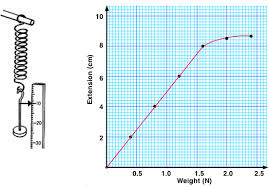
However when the elastic limit is approached, they are no longer proportional and the rate of extension decreases. Once an elastic material has hit the elastic limit, it will not recover its original shape.
1.29 describe experiments to investigate how extension varies with applied force for helical springs, metal wires and rubber bands
The experiment you will usually be asked about is:
- Attach a spring to a newton meter and measure its length
- Add a 50g weight and measure again
- continue to add increasing weights and take another measurement
- Do this up to 400g
- Plot a graph and yo will see that extension increases as force increases
1.25 know and use the relationship between the moment of a force and its distance from the pivot: moment = force × perpendicular distance from the pivot
Formula:
moment = force x distance from pivot
Moments are measured in Nm or Ncm
Force is measured in N
Distance is measured in m or cm
Remember! If it says mass is 100g that you need to convert that into Newtons:
1 kg = 10N
100g = 1N
The formula can be rearranged to form:
force = moment
distance from pivot
distance from pivot = moment
force
Examples:
 1. Calculate the moment on the right side = 0.5 x 5 = 2.5 Ncm
2. 2.5Ncm = ? ÷ 0.25
3. ? = 10 N
moment = force x distance from pivot
Moments are measured in Nm or Ncm
Force is measured in N
Distance is measured in m or cm
Remember! If it says mass is 100g that you need to convert that into Newtons:
1 kg = 10N
100g = 1N
The formula can be rearranged to form:
force = moment
distance from pivot
distance from pivot = moment
force
Examples:
 1. Calculate the moment on the right side = 0.5 x 5 = 2.5 Ncm
2. 2.5Ncm = ? ÷ 0.25
3. ? = 10 N
1.19 describe the factors affecting vehicle stopping distance including speed, mass, road condition and reaction time
Thinking distance: the distance that the car travels whilst the driver reacts to the hazard by pressing the brakes
Stopping distance: the distance that the car travels between the driver actually applying the brakes and the car coming to a halt.
Overall stopping distance = thinking distance + stopping distance
Thinking distance is affected by:
- concentration
- alcohol/drugs
- age
Braking distance is affected by:
- tyre condition
- road condition
- weather (wet/icy)
- condition of braes
- speed
- mass of car
Speed:
If speed is doubled, the kinetic energy that needs to be transferred from vehicle to driver is quadrupled. In order for the vehicle to stop, all the energy must be transferred.
Kinetic energy formula = 1mv2
2
If speed is doubled, the kinetic energy that needs to be transferred from vehicle to driver is quadrupled. In order for the vehicle to stop, all the energy must be transferred.
Kinetic energy formula = 1mv2
2
1.23 use the relationship between force, change in momentum and time taken: force = change in momentum ÷ time taken
Formula:
Force = change in momentum
time taken
This equations is used with questions like "How much force does the driver feel during this collision"
force
Force = change in momentum
time taken
This equations is used with questions like "How much force does the driver feel during this collision"
- The change in momentum would go from a velocity to a standstill as it collides with a stationary object
The formula can be rearranged to form:
Change in momentum = force x time taken
Time taken = change in momentum
force
1.22 use the conservation of momentum to calculate the mass, velocity or momentum of objects
Conservation of momentum:
Total Momentum before Collision = Total Momentum after Collision.
The best way to understand this is through examples.
Example (Collision):

3. When the bullet is released, it's momentum is 0.01kg x 400 m/s = 4
4. So to fulfil the conservation of momentum the momentum of the gun recoiling backwards has to be -4
5. So 10kg x ?m/s = -4
6. ? m/s = -0.4m/s
It's fine that this number is a negative. Velocity is a vector quantity so the negative sign jsut means it is moving backwards.
Total Momentum before Collision = Total Momentum after Collision.
The best way to understand this is through examples.
Example (Collision):

- So the momentum of A is 2kg x 5m/s = 10 kg m/s
Momentum of B is 3kg x 5m/s = 15 Kg m/s
2. The total momentum = 25 Kg m/s
3. So to fin out the velocity we first need to find the momentum of B after the impact.
- 3 kg x 7 m/s = 21 Kg m/s
- 25 Kg m/s - 21 Kg m/s = 4 Kg m/s
- This means that the momentum of A after the impact must be 4 Kg m/s
- So 2 Kg x ?m/s = 4 Kg m/s
- The answer is 2 m/s
Example (Explosion):
- A gun's mass is 10 kg and a bullets mass is 0.01 kg
and the velocity and which the bullet travels out of the gun is 400 m/s2. Since the gun and bullet are stationary, the momentum for both of them is 0
3. When the bullet is released, it's momentum is 0.01kg x 400 m/s = 4
4. So to fulfil the conservation of momentum the momentum of the gun recoiling backwards has to be -4
5. So 10kg x ?m/s = -4
6. ? m/s = -0.4m/s
It's fine that this number is a negative. Velocity is a vector quantity so the negative sign jsut means it is moving backwards.
1.21 use the idea of momentum to explain safety features
Cars are specifically designed to reduce the force transferred to the driver if a collision were to happen.
The safety features include:
The safety features include:
- The crumple zone which is the zone where the engine lies in front of the passenger and driver, collapses during a collision and increases the time for the vehicle to be brought to a halt and therefore reduces the force impacted on the driver.
- The seat belt also allows the passenger to come to a stop over a longer period of time, therefore reducing the force they are subjected to.
Subscribe to:
Posts (Atom)